


Ehime University Haiku Study Group
Matsuyama’s unique circle ” Ehime University Haiku Study Group”
Why don’t we all write haiku together?
To those of you who think, “Haiku is hard.” To put it simply, haiku is a lot of fun. I’ve included a guide on how to write simple haiku at the bottom of this page, so please take a look if you’d like.
One way to enjoy haiku is through haiku gatherings, where participants share the haiku they’ve composed. At these gatherings, everyone shows their haiku to the group, votes for their favorites, and discusses why they chose them. During this process, no one knows who wrote which haiku.That’s why the thrill of having your haiku selected, the time spent explaining why you chose it, and the tension of the moment when the author is revealed are simply irresistible.
They also contain important elements in everyday communication, and haiku is receiving attention in Japanese language classes.
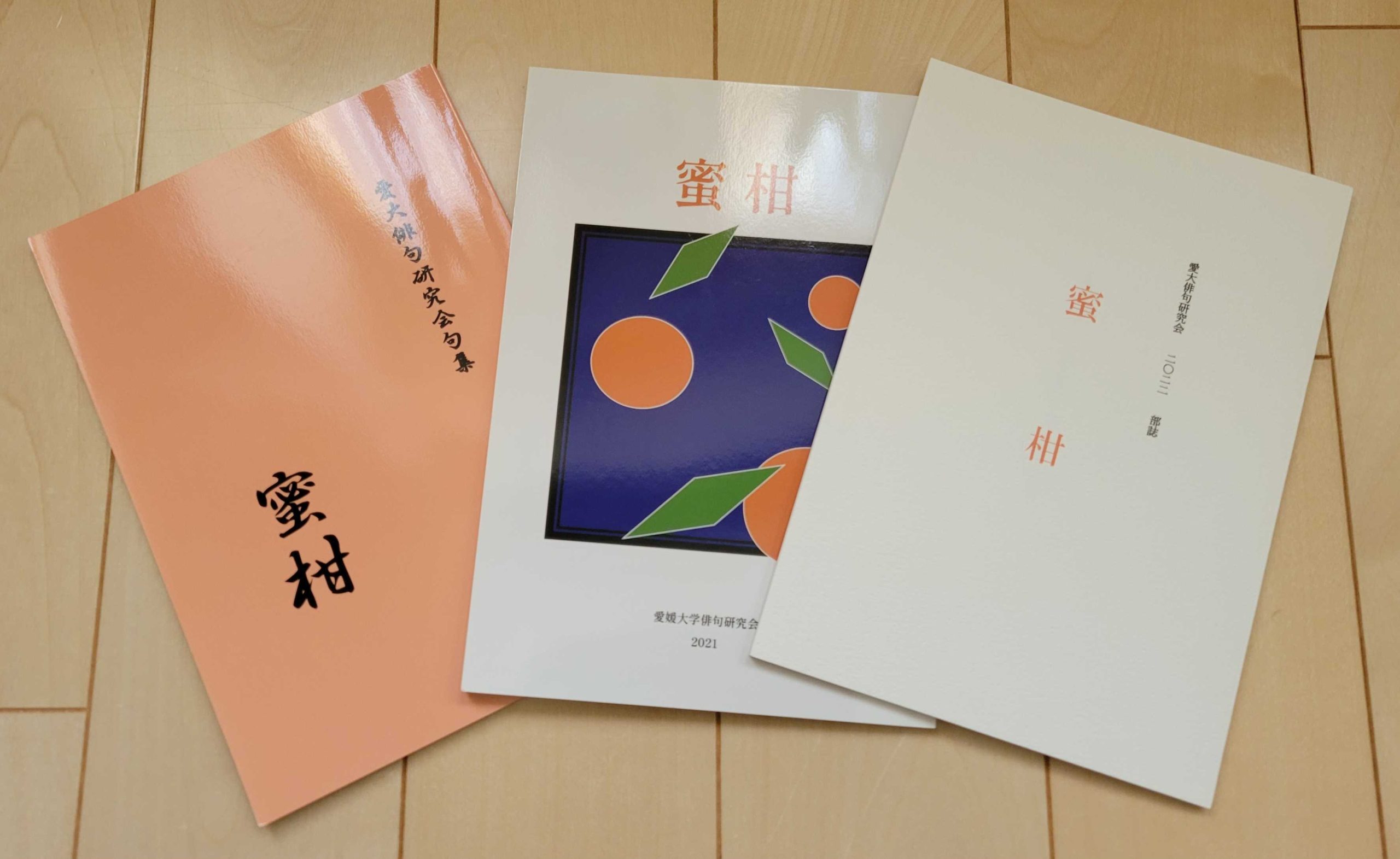
Ehime University Haiku Club holds weekly haiku meetings. On holidays, we organize “ginkō” outings to famous sites both within and outside the prefecture to compose haiku, and we also hold training camps during long school breaks. Additionally, we publish a club magazine featuring haiku composed by our members, timed to coincide with the student festival.
Furthermore, our club is closely involved in the operation of the “Haiku Koshien”—a national competition held annually in Matsuyama—as a supporting organization. In this way, while enjoying haiku itself, our club also engages in volunteer activities, such as serving as staff for various competitions and events, with the goal of “community development through haiku.”
Why don’t you experience haiku once, which is full of charm?
How to make a simple haiku (assortment)
For those who think “haiku is difficult,” here is a simple way to create haiku.
There are only two basic rules for writing haiku: “Compose it in a 5-syllable, 7-syllable, 5-syllable rhythm” and “Include exactly one seasonal word within the 17 syllables.” You may not be very familiar with the term “seasonal word.”
Seasonal words are terms that represent the seasons, such as “scarf” (winter), “tulip” (spring), and “summer vacation” (summer). The 5-syllable rhythm refers to pronouncing “tulip” as “tu-u-li-p”—five syllables.For “scarf,” it’s four syllables: “ma-fu-ra-o”; for “summer vacation,” it’s five syllables: “na-tsu-ya-su-mi.”
For example, let’s try writing a haiku using the seasonal word “spring breeze.” “Spring breeze” is a warm, refreshing, and pleasant seasonal word. If you place this seasonal word at the beginning of the haiku,
The Winds of Spring
And just like that, I’ve already completed one-third of the haiku. The remaining two-thirds—12 characters—will be finished as soon as I mutter something.
Right now, I’m writing an introduction for my club. So,
I’m working on an introduction to “Spring Breeze.”
And just like that, a haiku was born from a casual moment. The final phrase of this haiku, “In the process of creating,” is read in a 6-syllable rhythm.Haiku doesn’t have to follow the strict 5-7-5 rhythm (this is known as “short syllables” or “extra syllables,” respectively).
Doesn’t this haiku—“Creating an introduction to the spring breeze”—convey the feeling of eagerly writing an introduction while anticipating the arrival of new club members, inspired by the warm and refreshing image of the spring breeze?
Now, if we were to change this season word to “winter winds,”
I’m working on an introduction to “Winds of Winter.”
When you think of the cold, bleak image of a winter wind, doesn’t it somehow conjure up a stern scene that looks like the club is on the verge of being disbanded?
This difference in perception stems from the power of seasonal words, and it’s also part of the fun of choosing them. As you can see, haiku are easy to write.
Contact Us
Contact aidai.haikuken@gmail.com
I post updates about our activities on X (@Aidai_Haiku) and Instagram (aidai_haiku). Please search for “Ehime University Haiku Society” and check it out. We also accept membership applications there.
| advisor | Makoto Nakanishi |
|---|---|
| Student Representative | Haruna Taniguchi |
| number of members (e.g. club members) | 10 men, 8 women (as of May 2026) |
| Active Time | We hold haiku gatherings every Friday from 6:30 p.m. to 9:00 p.m. (We adjust the day of the week each quarter to make it more convenient for everyone.) We also hold occasional field trips to compose haiku, as well as retreats during long school breaks. Sometimes we’re active, and other times we take it easy—that’s the kind of club we are. We’d love for you to participate in whatever way feels right for you. |
| Place of activity (name of facility) | Extracurricular Activities 1st Common Facilities 2nd Floor |
| Club fee (monthly) | Free |
| circle box | ant |